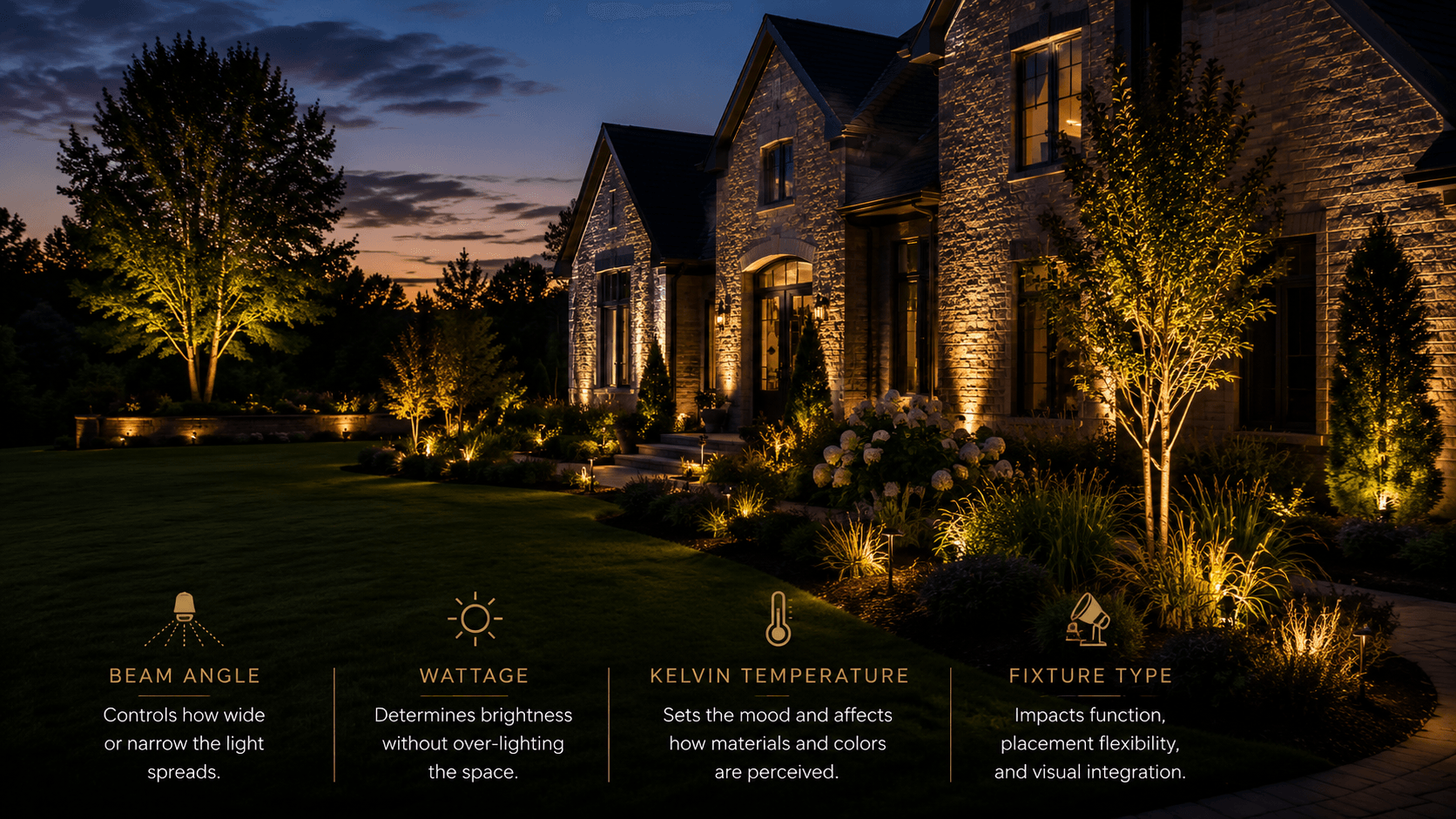
A landscape lighting design isn't fixture selection — it's a sequence of decisions about light itself. Beam angle, wattage, color temperature, and fixture type are each a continuous spectrum, and the right choice on every axis depends on what's being lit and how the property reads from where it's seen.
What follows is how a designed plan makes those decisions, and why the same set of fixtures can produce a beautifully lit home or a parking-lot impression depending on which numbers were picked.
Read the property before you pick a fixture
Every design starts with the house itself — its architecture, its materials, the planting around it, and the way the property is used. This is where focal points reveal themselves: where the architecture wants emphasis, where a tree stops being a daytime green mass and becomes a structural form worth lighting, where the eye should land first.
A property walk produces three things: a list of focal points (what to light), a list of supporting elements (what to layer), and a clear sense of what to leave dark. The dark spaces are as important as the lit ones — without them, there's no contrast, and without contrast, nothing reads.
Beam angle: narrow vs. wide isn't a preference
Beam angle is the spread of light a fixture produces, measured in degrees. The choice isn't aesthetic — it's structural.
- Narrow beams (15–25°): focal-point work — single specimen tree, statue, architectural detail, column
- Medium beams (35–45°): general accent on small façade sections, shrub beds, smaller features
- Wide beams (60°+): full-façade washes, broad ground coverage, large canopies
Wattage and the difference between bright and visible
Wattage controls brightness, but the relationship between wattage and how a fixture reads isn't linear. A 4W LED on a small tree at fifteen feet looks substantial; the same 4W on a thirty-foot oak disappears.
A designed system uses fixtures across a wattage range — typically 2W to 12W in modern LED — and selects each by what it's lighting, not by uniform spec. Pathway fixtures sit at 2–3W. Tree uplights sit at 4–8W on medium trees, 10W+ on mature canopies. Façade washes sit at 6–12W depending on the surface and distance.
Color temperature: the difference between elegant and clinical
Color temperature, measured in Kelvin (K), is the warmth or coolness of the light. The number that gets picked is one of the most influential decisions in the entire design — and the most commonly wrong on builder-grade installs.
- 2700K (warm white): patios, seating areas, anything where the property is being lived in. Cozy, intimate, the right answer for residential entertaining
- 3000K (warm-neutral): trees, shrubs, mid-range architectural lighting. The default for most residential landscape work
- 3500K (neutral): contemporary architecture, stone façades, modern landscapes. Crisp without feeling cold
- 4000K+ (cool white): commercial, sports, security floodlights. Almost never appropriate for residential design
Fixture type matches the technique
Path lights illuminate ground. Uplights illuminate vertical surfaces. Downlights illuminate ground from above. Specialty fixtures — bullet, well, flood, hardscape — handle specific situations the standard three can't.
A designed plan uses every type. A typical residential project includes:
- 8–12 path lights with shielded heads
- 10–20 uplights, mostly brass, in a mix of beam spreads
- 3–6 downlights in canopy or under eaves for ground moonlight
- Hardscape lights inset into stairs, walls, or grade changes
- 1–3 specialty fixtures for water, statuary, or unusual features
The decisions that come last
The last decisions in a design are the smallest: trim caps to control glare, lens diffusers to soften an edge, slight aim adjustments to widen or tighten an effect. None of these show up on a fixture spec sheet — they show up at night, with the system on, with someone walking the property looking at what reads and what doesn't. That's where a design becomes a finished installation.
Frequently asked
Common questions
- What's the right color temperature for residential landscape lighting?
- 2700K–3000K is appropriate for almost all residential landscape lighting. 2700K for outdoor living spaces and entertaining, 3000K for trees, shrubs, and most architectural lighting. Anything 4000K or above reads as commercial.
- How do I know what beam angle I need?
- Match the beam to the subject. Narrow (15–25°) for single focal points like specimen trees or statues. Medium (35–45°) for accent on smaller features. Wide (60°+) for façade washes and broad coverage. A designed system mixes all three.
- Can a custom landscape lighting design be retrofit onto an existing system?
- Often, yes. We frequently retrofit existing systems by replacing halogen lamps with proper LED equivalents, re-aiming every fixture, and adding fixtures where the original layout missed coverage. The transformer and wire infrastructure usually carries forward.
- How long does a custom lighting design take from start to finish?
- A typical residential project runs 4–8 weeks from first photos to final aiming, depending on scope. The design itself takes 1–2 weeks; installation 1–3 days; the final tune-and-aim happens at dusk on a separate visit after the system has been live for a week.
About the author

Daniel Whitehead
Founder & Lighting Designer
Daniel Whitehead is the founder of Landscape Lighting Pro, a Peachtree City–based studio specializing in custom landscape lighting design and installation across the Greater Atlanta area. The studio works exclusively in lighting — every project begins with a drawn plan tailored to the home, then tuned in place at night.
Related services