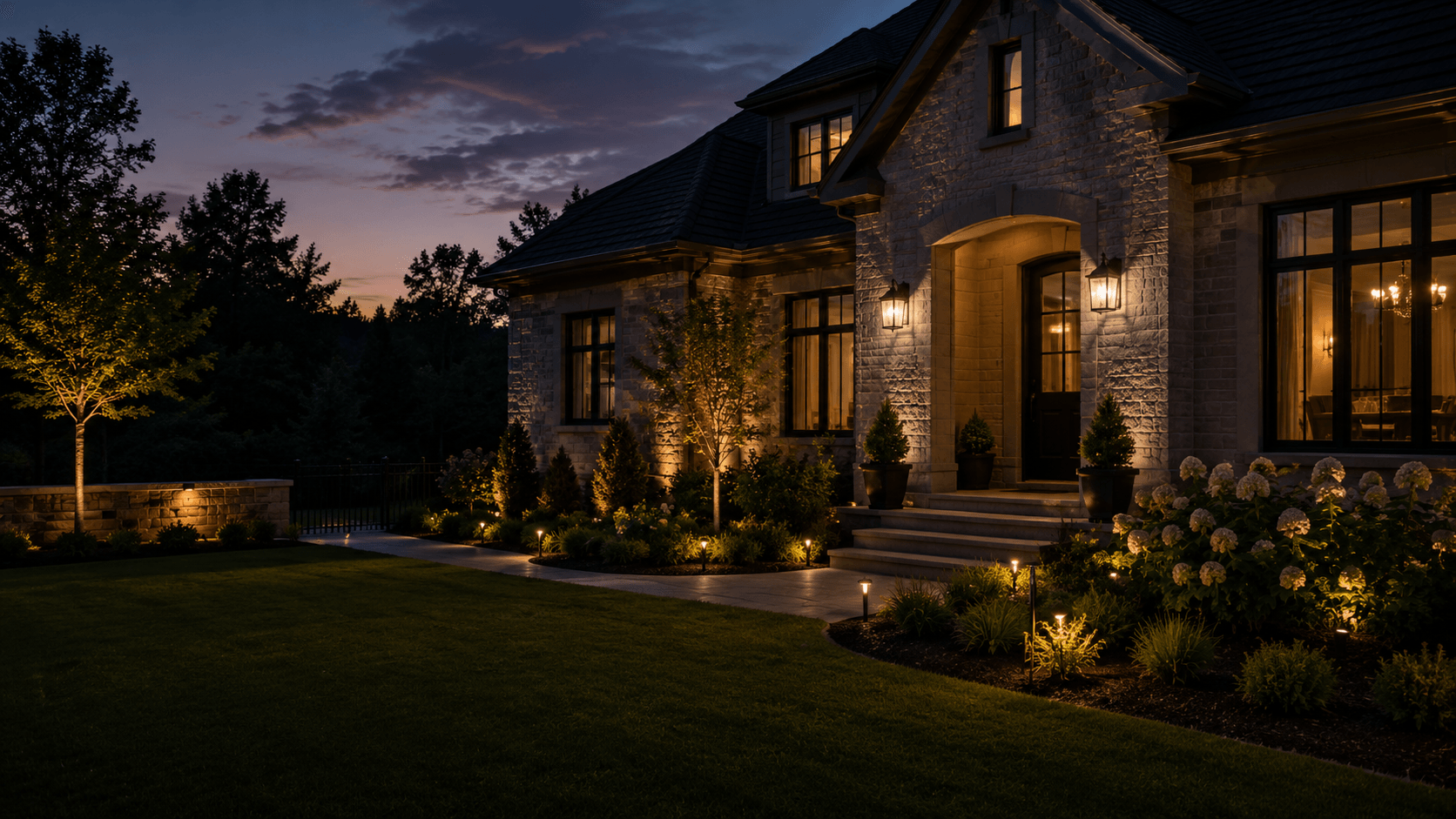
A well-lit property is a safer one — that part is uncontroversial. The harder question is what "well-lit" actually means. The instinct is that brighter is better; the answer is almost always the opposite. Strategic, layered light at the right places makes a property both safer and more inviting. Floodlights make it neither.
Below, how a designed lighting plan handles the four problems homeowners actually want solved: deterrence, visibility, water-feature safety, and wayfinding.
Deterrence isn't brightness — it's coverage
Studies of residential break-ins consistently find that what deters intruders isn't a bright property, it's a property with no dark corners. A glaring floodlight over the garage casts a long, dark shadow next to the house — exactly where someone would hide. A modest perimeter wash from below leaves no shadows to work with.
Designed deterrence lighting works in four places: at every entry point (front and side doors, garage), along the foundation perimeter on three sides of the home, on the approach to the property from the street, and at any architectural recess that would otherwise be in shadow. None of these need to be bright. They need to be present.
Trip-hazard visibility, without runway lights
Falls on uneven ground are the most common nighttime accident on residential properties. The fix isn't to line every walkway with stake lights spaced six feet apart — that creates glare cones that destroy night-vision adaptation as you walk through them. The fix is shielded, downward-aimed light that reveals the ground without lighting the eye.
What that looks like in practice:
- Path lights with hooded fixtures (the source isn't visible to a walker), spaced 8–12 feet apart
- Step lights inset into risers, not mounted above them
- Downlight from above where a tree canopy or eave allows it — gentler than ground-level fixtures
- An intentional gradient on grade changes (the eye reads them as elevation cues)
Pool, pond, and water-feature lighting
Water introduces a second-dimension safety problem. The reflective surface bounces light, the depth obscures the bottom, and any nighttime movement near unlit water is a fall risk. Code in most jurisdictions requires lighting around any pool deeper than 18 inches; design instinct says treat ponds and water features the same.
Underwater fixtures are rated to specific submersion depths; perimeter lighting is sized to keep the deck clearly readable without glare on the water surface. Both belong on a separate dimming circuit so the brightness can be tuned by the activity — bright for evening swims, low and atmospheric for a dinner.
Entries, paths, and arrival
The first thirty feet of an arrival are the most important. A guest walking from car to door is judging where the front door is, what the surface underfoot is doing, and whether they're welcome. All three are lighting decisions.
We light arrivals with a combination of moonlight from above (when a canopy or eave allows), low pools at grade, and a single warm wash on the door itself. The face of the home is the focal point; everything else supports it.
Energy and longevity
A property-perimeter lighting plan in modern LED runs roughly 200–400W total — comparable to a single old halogen floodlight, distributed across thirty fixtures. With proper LEDs (rated 30,000+ hours), the maintenance cycle is measured in years, not seasons.
Frequently asked
Common questions
- Does landscape lighting actually deter burglars?
- Strategic perimeter lighting reduces residential burglary risk meaningfully. Research from organizations like the U.S. Department of Justice has found that illuminated entries and approaches lower attempt rates. A bright floodlight over the garage doesn't help; light at every entry, eliminating shadows, does.
- Should security lights be on motion sensors or always on?
- Both, layered. Always-on perimeter lighting at low levels means the property never reads as "dark" — that's the deterrent. Motion-activated brighter lights at side and rear entries add a second layer when someone approaches.
- How bright should pathway lighting be?
- Lower than instinct says. The goal is to make the ground readable, not to flood it. Most professional path lights use 2–4W LED bulbs and are placed roughly 8–12 feet apart with shielded heads.
- Is landscape lighting around a pool required by code?
- Most jurisdictions require pool-area illumination after dark, and any underwater or wet-location fixture must be UL-listed for the depth and contact involved. Confirm requirements with your local building department before installing.
About the author

Daniel Whitehead
Founder & Lighting Designer
Daniel Whitehead is the founder of Landscape Lighting Pro, a Peachtree City–based studio specializing in custom landscape lighting design and installation across the Greater Atlanta area. The studio works exclusively in lighting — every project begins with a drawn plan tailored to the home, then tuned in place at night.
Related services