Big-box low-voltage kits aren't dangerous, and they aren't bad. For a small property with a few simple aims, they can do the job. The case for hiring a professional landscape lighting company isn't "safety vs. unsafe" — it's about what the system looks like at night and how it holds up over time.
Three things separate a professional installation from a DIY one: safety choices that aren't obvious, technical decisions that don't reveal themselves until two years in, and a design that treats the property as a composition rather than a checklist of fixtures. Below, what each of those actually means.
Where DIY low-voltage works fine
If your property is small, your goals are functional (lighting a path, putting some glow on a few shrubs), and you're willing to replace the system in five or six years, a hardware-store kit can absolutely meet the brief.
Where DIY breaks down: large properties with long wire runs (voltage drop becomes a real problem), homes where you actually want the lighting to be a visible part of the architecture, and any setup involving water — pool perimeters, fountains, or wet planting beds.
Safety: the obvious things and the non-obvious ones
Low-voltage 12V systems are safer than 120V line-voltage systems by a wide margin — that's true. The risks that actually appear in the field are subtler than electrical shock.
- Buried connections that aren't waterproofed properly, then corrode over a winter
- Undersized transformers that run hot and fail in three years instead of fifteen
- Wire runs sized for the kit's first five fixtures but not the eight you added later, dropping voltage at the far end and shortening lamp life
- Trip hazards from cables run across walkways instead of buried alongside them
The technical decisions that show up at year three
Wire gauge, voltage drop, and transformer sizing aren't visible the day a system goes in. They're visible in year three, when half the lamps at the far end of a run have dimmed or failed because the system was wired with 16 AWG when it needed 12 AWG.
A professional designer calculates voltage drop for every run, sizes the transformer at roughly 80% of expected load (so it has headroom), and chooses fixtures with replaceable lamps so the system isn't disposable. None of those decisions are hard — they're just decisions DIY kits don't ask you to make.
Design is the part DIY can't fix
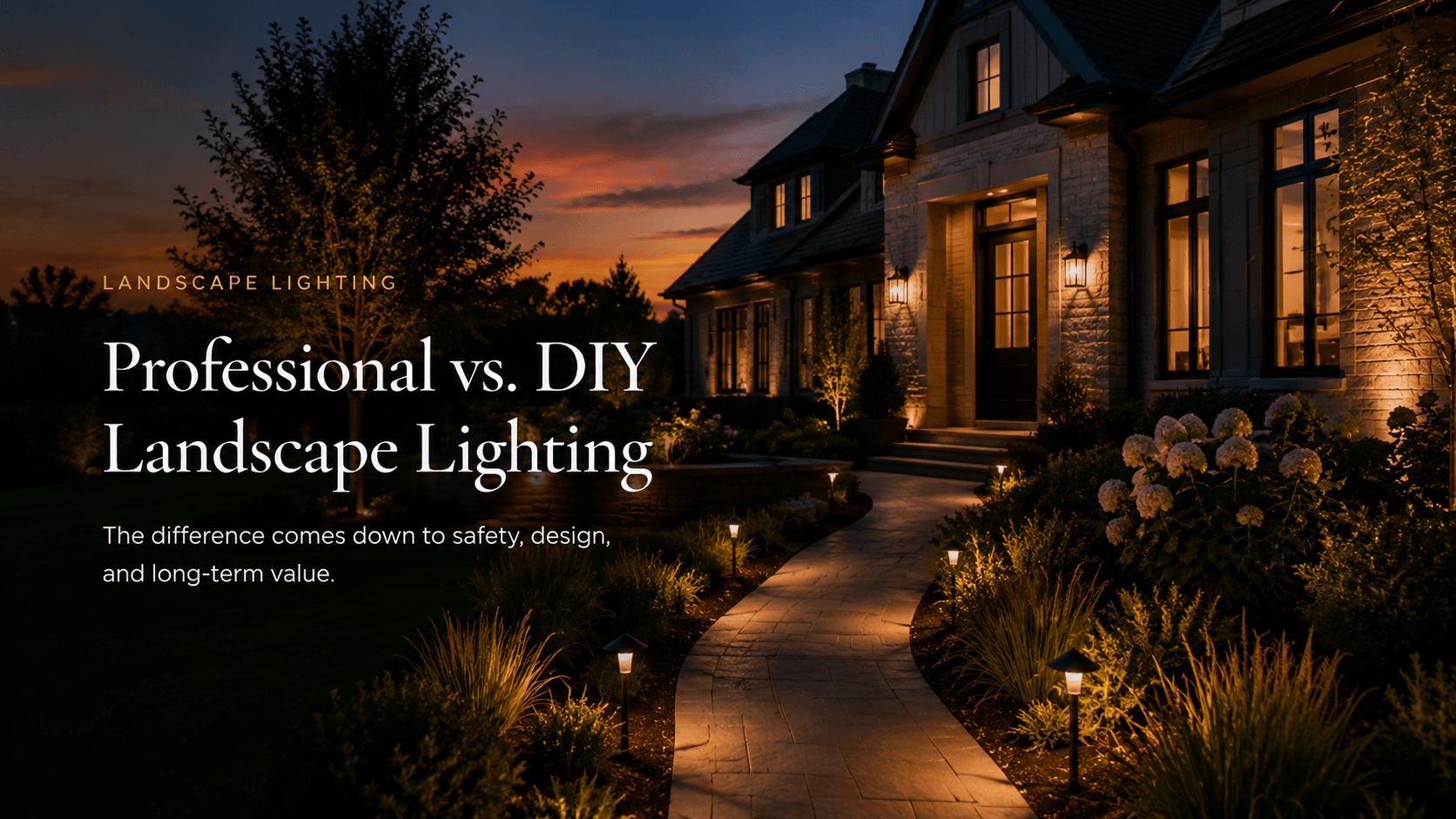
The biggest difference between a DIY install and a professional one isn't the fixtures or the wiring. It's the design — what gets lit, how, and from where. A professional design treats the property as a composition: layered light from multiple heights, narrow beams on focal points, wider washes on architecture, intentional dark spaces between the lit ones.
A DIY install lights things. A designed install reveals them. The difference is the difference between a property that has lights and one that has been lit.
When to hire a professional
- Properties over a quarter-acre, or with long wire runs
- Homes where the architecture is worth lighting deliberately — stone, brick, columns, a notable façade
- Pool perimeters, water features, and any wet area
- Mature trees you want to uplight (canopy lighting is hard to get right without ladders and proper aiming)
- Any property where the lighting is part of the entertaining, not just the path-finding
Frequently asked
Common questions
- How much does professional landscape lighting cost compared to DIY?
- A professional design and installation typically runs 5–10× the cost of a DIY kit, but with replaceable-lamp brass fixtures, properly sized transformers, and a design that's been aimed and tuned in the dark. The right comparison isn't the day-one price — it's the cost over fifteen years.
- Is low-voltage landscape lighting really safer than line voltage?
- Yes — 12V systems carry far less risk of electrical shock than 120V. The remaining risks (corroded connections, voltage drop, undersized transformers) are about installation quality, not voltage.
- Can I add to a DIY system over time, or do I have to start over?
- It depends on whether the original transformer and wire gauge have headroom. Most DIY kits don't — they're sized for exactly the fixtures in the box. Adding more fixtures usually drops voltage at the existing ones and shortens their life.
- How long does a professionally installed landscape lighting system last?
- A properly designed brass-and-LED system should run 15–25 years with seasonal maintenance, with the LED lamps themselves rated 30,000–50,000 hours. Halogen and aluminum kits typically last 5–8.
About the author

Daniel Whitehead
Founder & Lighting Designer
Daniel Whitehead is the founder of Landscape Lighting Pro, a Peachtree City–based studio specializing in custom landscape lighting design and installation across the Greater Atlanta area. The studio works exclusively in lighting — every project begins with a drawn plan tailored to the home, then tuned in place at night.
Related services