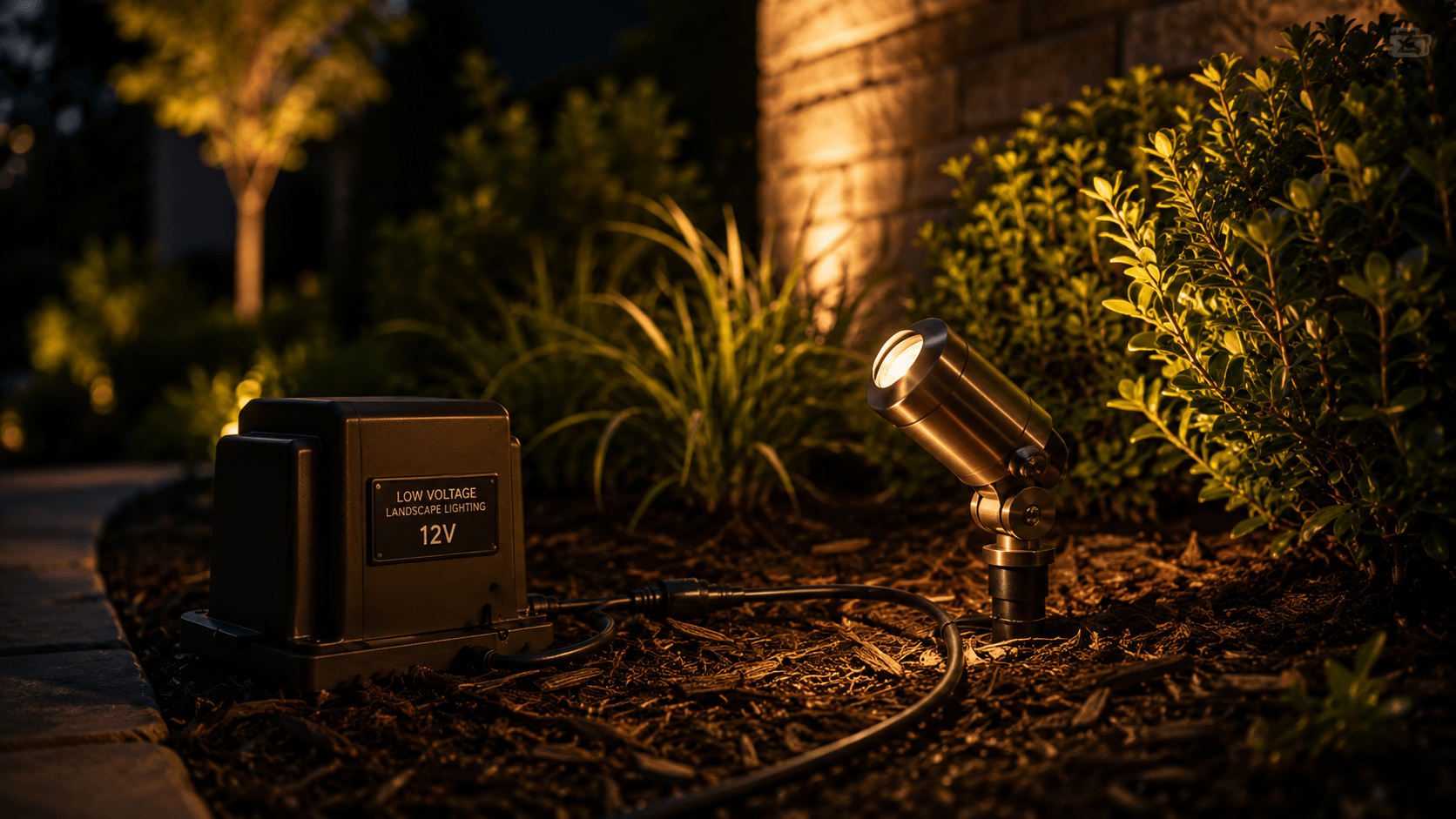
The residential landscape lighting industry has been almost entirely 12V low-voltage for two decades, and for good reason. Low-voltage systems are safer to install and live around, more energy-efficient, easier to add to over time, and produce light that reads better on a residential scale than the floodlight-and-line-voltage approach they replaced.
Below, the actual reasons low-voltage has become the standard, and the trade-offs that still matter to know.
12V vs. 120V: the practical differences
Line-voltage 120V systems run on the same circuits as the rest of the house. Low-voltage systems use a transformer that steps house power down to 12V before it reaches the fixtures.
- Wire trenching: line-voltage requires conduit and code-mandated burial depth (typically 18 inches for direct-bury cable, 6 inches in conduit). Low-voltage cable can sit a few inches under mulch.
- Shock risk: meaningfully present at 120V, negligible at 12V
- Permits: line-voltage almost always requires permits and a licensed electrician. Low-voltage typically doesn't.
- Adding fixtures: line-voltage means re-trenching and tying into a circuit. Low-voltage means a connector and a stake.
Energy and cost
Modern LED low-voltage fixtures draw 2–12W each, compared to 35–90W for the older halogen low-voltage fixtures they replaced — and a fraction of what the line-voltage floodlights they replaced consumed.
A typical residential property with thirty fixtures running six hours a night runs about 50¢–$1.50 per night in electricity at current US residential rates. The same number of older halogen fixtures would have run roughly $3–$5 per night. The line-voltage floodlight approach was an order of magnitude higher again.
What low-voltage doesn't do well: voltage drop
The longer a low-voltage wire run, the lower the voltage at the far end — and below about 10.5V, lamps dim and lifespan drops. This is the single most common reason DIY low-voltage systems disappoint after a year: the wire was sized for the first five fixtures, not for the eight that got added.
A designed system handles voltage drop with three tools: appropriate wire gauge (12 AWG on long runs, not 16 AWG), a hub-and-spoke topology rather than a single daisy chain, and multi-tap transformers that can deliver 12V, 13V, 14V, or 15V at the source so the far end of a run lands in spec.
Fixture longevity, properly
The lifespan claim around low-voltage fixtures gets oversold. The lamps inside a quality LED fixture are rated 30,000–50,000 hours — that's 15–25 years of nightly residential use. The fixture housings are the limit: aluminum housings corrode in 5–8 years; brass and copper housings outlive the lamps.
Specifying a system in solid brass or copper from a serious manufacturer is the difference between buying a lighting system and buying a disposable one. The wire and transformer are commodity. The fixtures are the long-term decision.
Where low-voltage wins on design
Beyond the practical, low-voltage made design flexibility possible. The fixtures are smaller (no line-voltage junction box, no conduit), which means they can hide. They run cooler, which means they can sit under mulch or against a tree trunk without scorching anything. They draw less, which means a property can have thirty intentional fixtures instead of three loud floodlights.
Most of what defines modern residential landscape lighting design — layering, restraint, hidden sources, intentional dark spaces — is only achievable at 12V.
Frequently asked
Common questions
- Is low-voltage landscape lighting bright enough?
- For residential design, yes — the question is wrong. Modern LED low-voltage fixtures produce more usable light per watt than older systems, and "bright enough" isn't the goal. Layered, intentional light is.
- How much does a low-voltage landscape lighting system cost to install professionally?
- A professionally designed and installed brass low-voltage system in the Atlanta area typically runs $4,000–$25,000+ depending on property size, fixture count, and complexity. The fixtures themselves are usually 50–60% of the project cost.
- Can I run a low-voltage system off solar or battery?
- Solar path lights exist, but they're a different category — typically much dimmer, no transformer, no design flexibility. A real low-voltage landscape lighting system runs from a hardwired transformer connected to house power.
- How long do LED low-voltage fixtures last?
- The LED lamps themselves are rated 30,000–50,000 hours of operation, which works out to 15–25 years at typical residential use. Brass or copper housings outlive the lamps; aluminum housings often don't.
About the author

Daniel Whitehead
Founder & Lighting Designer
Daniel Whitehead is the founder of Landscape Lighting Pro, a Peachtree City–based studio specializing in custom landscape lighting design and installation across the Greater Atlanta area. The studio works exclusively in lighting — every project begins with a drawn plan tailored to the home, then tuned in place at night.
Related services